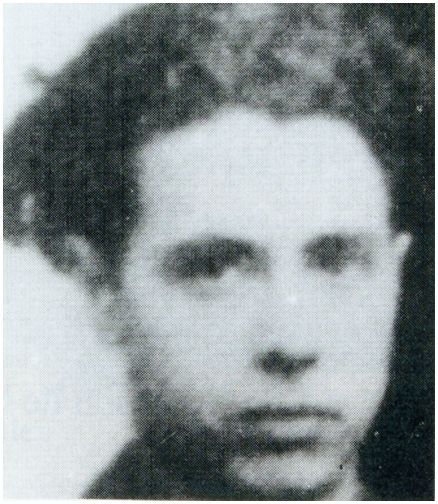
Marcel Carrier

Born in Paris on 29 April 1922, Marcel Carrier joined the French JOC at an early age and rapidly became a federal leader.

Still aged only 18, he married on 3 August 1940. He and his wife had three children.

However, he was called up for Compulsory Labour Service (STO) just days after the birth of his third child.

He left for Germany at the beginning of August 1943 out of fear of reprisals against family members. He was sent to Weimar where he became a leader in the clandestine Catholic Action movement. He took part in a secret meeting of militants on 15 August and another on 4-5 September.

Priest prisoners, who had hidden their clerical identity, joined them in organising masses.

Although the sending of books from France was prohibited, he managed to launch a library.

Every Sunday he travelled around the region to develop contacts and organise meetings. He and Jean Tinturier were the two main organisers of the “Thuringia Federation.”

He was arrested at Weimar on 17 April 1944. He was interrogated by the Gestapo at Gotha, where he was subsequently along with 11 companions.

On 25 September, he signed the official document convicting him for “his Catholic action among his French comrades during his compulsory labour service” and being “a danger to the German state and people.”

On 12 October 1944 he was sent to the Flossenbürg camp where he was given N° 28 905.

According to the testimony of survivors, he died at Neustadt-sur-Tachau on 6 May 1945 while being evacuated from Flossenbürg. Still aged only 23, he left his wife and three children.

SOURCES
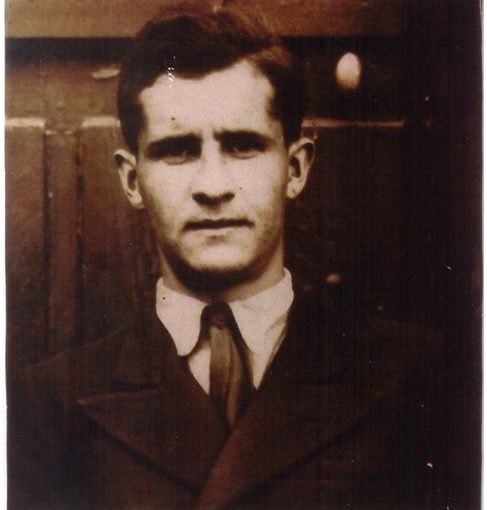
Marcel Carrier (Mémoire et espoirs de la Résistance)

Jean Tinturier, friend of Marcel Callo

Jean Tinturier was born in Vierzon (Cher) on 20 February, 1921.

After completing his secondary studies, he became a seminarian in the diocese of Bourges. In October 1938, he entered the St Sulpice seminary in Issy-Les Moulineaux, then in 1942 the Carmelite seminary in Paris.

Having reached the age required to leave for compulsory service in Germany established by a Vichy law in 1943, he obtained a deferral as a student to complete a training course as a milling machine operator in Dijon and as a turner in Ivry.

The objective was to gain the skills necessary to go to work in support of French workers doing forced labour in Germany and to hide his status as a seminarian.

Called up for compulsory labour service (STO) on 21 September 1943, he left for Schmalkaden with three other seminarians.

In addition to his eleven hours of work per day in front of a lathe, he organised a mass in French once a month for the 150 Christian workers present at the Sunday mass at the local Catholic Church, out of 800 French workers.

He made contact by mail with the leaders of the clandestine Young Christian Workers in Germany to help them provide moral support to each other.

He also made contact with the priests and seminarians of the neighbouring towns: Eisenach, Gotha, Erfurt. They organised and organised reflection meetings.

Among those he contacted was Marcel Callo, who he recruited to assist in his organising work.

As early as March 1944, they learned of the Gestapo’s ban on any religious movement, particularly the YCW. As a result, Jean Tinturier decided to cease all outside activity.

Nevertheless, he was arrested on 18 April 1944 for “illegal activity” and convicted of Catholic Action. While being held by the Gestapo in Gotha, he was interrogated by a specialist in religious matters.

He joined eleven companions arrested for the same reason at Gotha prison.

On 25 September, 1944, he was convicted for the following reason: “By his Catholic action with these French people, during his compulsory labour service, he was a danger to the German state and people.”

Sent to the Flossenbürg camp where he was given the number 28903, he was then transferred to the camps of Mauthausen with the number 108814, then Auschwitz with number 200000, then Mauthausen, with number 123558, where he died on 16 March 1945, three days before Marcel Callo.

SOURCE

T1 Martyrs de la résistance spirituelle, Charles Molette, éd. X. de G., 1999, et Jean Tinturier, C. Molette, éd. X. de G., 2008

The Nerdy-Looking Martyr (Catholic Saints Guy)