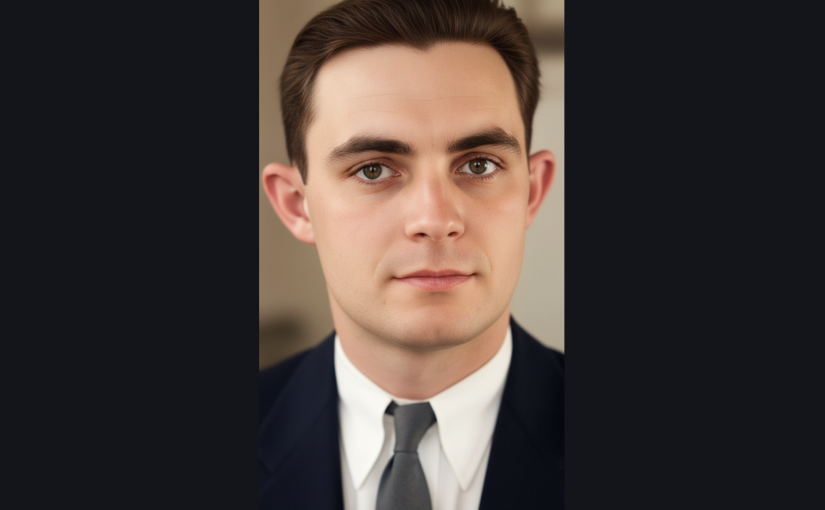
Marcel Carrier

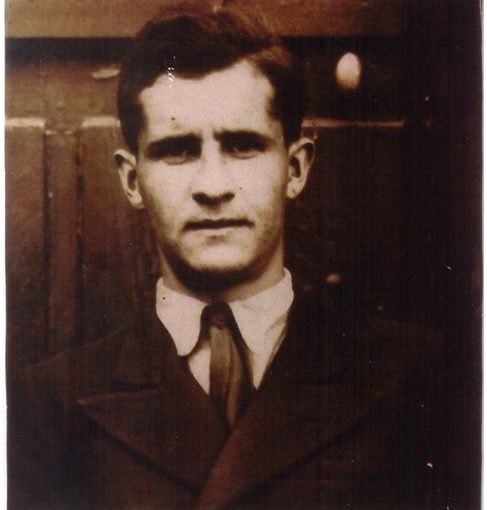
Born in Paris on 29 April 1922, Marcel Carrier joined the French JOC at an early age and rapidly became a federal leader.

Still aged only 18, he married on 3 August 1940. He and his wife had three children.

However, he was called up for Compulsory Labour Service (STO) just days after the birth of his third child.

He left for Germany at the beginning of August 1943 out of fear of reprisals against family members. He was sent to Weimar where he became a leader in the clandestine Catholic Action movement. He took part in a secret meeting of militants on 15 August and another on 4-5 September.

Priest prisoners, who had hidden their clerical identity, joined them in organising masses.

Although the sending of books from France was prohibited, he managed to launch a library.

Every Sunday he travelled around the region to develop contacts and organise meetings. He and Jean Tinturier were the two main organisers of the “Thuringia Federation.”

He was arrested at Weimar on 17 April 1944. He was interrogated by the Gestapo at Gotha, where he was subsequently along with 11 companions.

On 25 September, he signed the official document convicting him for “his Catholic action among his French comrades during his compulsory labour service” and being “a danger to the German state and people.”

On 12 October 1944 he was sent to the Flossenbürg camp where he was given N° 28 905.

According to the testimony of survivors, he died at Neustadt-sur-Tachau on 6 May 1945 while being evacuated from Flossenbürg. Still aged only 23, he left his wife and three children.

SOURCES

Marcel Carrier (Mémoire et espoirs de la Résistance)

Jean Préhu, YCS leader and Scout

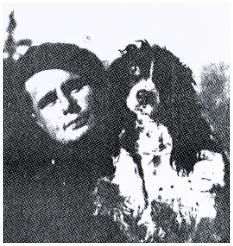
Jean Préhu, born on 27 March, 1920, in Laval, France, was a devoted Scout and an active member of the Jeunesse Étudiante Chrétienne (Young Christian Students – JEC). From an early age, he was formed in a spirit of faith, solidarity, and service. These values would later shape his courageous resistance to the Nazi regime, ultimately leading to his martyrdom.

Préhu enlisted in the French army on 13 October, 1938, serving in the 39th Fortress Artillery Regiment at Metz. He was taken prisoner on 17 June, 1940, near Strasbourg, and deported to Germany. Held at Stalag VI H in Düren and later at VI G in Bonn, he met fellow prisoners like Raymond Louveau and Abbé Rondeau. At Kommando 624, he formed a clandestine Christian support group modeled after Scout and JEC methods, working alongside Jean Bernier and Father Harignodoquy.

This underground network, which promoted Christian fraternity and reflection on social issues, was considered subversive by the Nazi authorities. In August 1944, Préhu was arrested by the Cologne Staadtpolizei in violation of the Geneva Convention. He was deported to Buchenwald concentration camp on 17 September, 1944, and registered as prisoner number 81817. He was later transferred to Langensalza Kommando.

Jean Préhu died on 27 April, 1945, during the strafing of the infamous “death train” headed to Dachau. In 1983, he was officially recognised as a déporté résistant (deported resister) by the French government.

In 2024, the Vatican formally included Jean Préhu among the group of 50 French Catholic martyrs whose beatification cause is underway, recognising them as victims of hatred of the faith (odium fidei). Préhu’s unwavering commitment to faith and justice remains a profound witness for today’s world.

Sources:

  1. Vatican – Causes of Saints
    https://www.causesanti.va/it/santi-e-beati/cayre-cendrier-vallee-mestre-e-46-compagni.html
  2. Mémoire et Résistance – Jean Préhu (by Dominique Morin)
    https://www.memoresist.org/resistant/jean-prehu/
  3. Le Salon Beige – 50 French Catholics Martyred by the Nazis to Be Beatified
    https://lesalonbeige.fr/cinquante-catholiques-francais-tues-par-le-regime-nazi-reconnus-martyrs-et-bientot-beatifies/
  4. Saint-Ouen – List of Recognised Martyrs
    http://perso.numericable.com/gabriel.floricich/saint-ouen/pages/y-carrier_liste_martyrs.html
  5. Association Buchenwald-Dora – Jean Préhu
    https://asso-buchenwald-dora.com/prehu-jean-klb-81817/
  6. DUMAS – Université de Bretagne Sud, MA Thesis on French Martyrs
    https://dumas.ccsd.cnrs.fr/dumas-02086417v1/file/2018%20-%20RADIGUET%20DE%20LA%20BASTAIE%20%20His.pdf

Article written and compiled by Roshan Melwyn Lobo, Secretary General, International Young Catholic Students (IYCS-JECI).

SOURCE

Jean Préhu: A Scout, Young Christian Student, and Martyr on the Path to Beatification (IYCS-JECI)

From Student to Saint: Jean Chavet, JEC/YCS Martyr of Faith and Courage

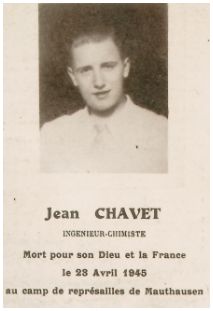
Born on 10 August, 1922, in Saint-Étienne (Loire), Jean Chavet was a brilliant student. At the age of 20, he ranked first in his class at the School of Industrial Chemistry in Lyon and was planning to pursue a doctorate after receiving the Victor Grignard Prize for his bachelor’s degree in science, which he completed at the same time.

Having reached the required age for departure to the Compulsory Work Service (STO), his father advised him to volunteer in order to be able to choose his job in Germany. But Jean was also very committed in his parish as a JEC (Young Christian Students) member.

At the end of the academic year, he left on 6 June, 1943.

In Germany, he was assigned to Halle as a researcher in a chemistry laboratory at the Buna-Werke factory in Schkopau near Merseburg, a synthetic rubber manufacturing plant. He shared Room 22 with other chemical engineers. They could have remained separated from the other forced workers (STOs), occupying a superior social position a status favored by Nazi ideology.

However, the forbidden activities he carried out as soon as he left the factory reflected his solidarity with other French workers in the camp. He was often asked for help because of his excellent command of German. This Catholic group in the “chemists’ barrack”, with chaplain Pascal Vergez, devoted themselves to serving the 1,200 French STOs in the camp, which included former JEC members, JOC (Young Christian Workers) members, and scouts.

Jean became Vice-President, then President, of the Amicale des Travailleurs Français (French Workers’ Association), which organized recreational activities and mutual aid services for the most disadvantaged.

His companion, Guy Barbier de Courteix, recalled that at work:

He only submitted brief results to his supervisor and kept the discovery secret. This meant a lot more work for him, but he preferred it that way… Where Jean was truly admirable was in not letting himself be carried away by his knowledge… A natural instinct would be to try to make progress, but his patriotic sense demanded restraint.

Following the Nazi decree of 3 December, 1943, which targeted French Catholic Action among French workers in Nazi Germany, he was arrested on 2 November, 1944, at the factory — the third to be taken after the chaplain and the delegate, whom he had ended up replacing.

He was interrogated and tortured in Halle prison like the others, in an attempt to force him to betray his companions. He contracted typhoid fever in prison in February 1945.

He was deported on 2 March, 1945, to the Mauthausen concentration camp (prisoner number 135090). On 23 April, he was found still alive near the crematorium. He said to one of his companions who came to see him, thinking of the planned pilgrimage to Lourdes after their return:

“If I cannot go to Lourdes on earth, I will go to Lourdes in heaven. I have exhausted myself too much at Buna for the sake of my comrades. Now, I will go and rest.”

He died on 24 April, 1945, thrown into the cremation oven — dead or still alive?

By Dominique Morin | Translated and adapted by IYCS-JECI International Secretariat

References & Bibliography

Morin, Dominique. Jean Chavet : un parcours jéciste – JEC France
https://jecfrance.org/jean-chavet-un-parcours-jeciste/
Jean Chavet – Mémoire et Résistance – Mémoire Résistante
https://www.memoresist.org/resistant/jean-chavet/
List of Soon-to-Be Beatified Individuals – GCatholic.org https://gcatholic.org/saints/beati-L14

SOURCE

“From Student to Saint: Jean Chavet, JEC/YCS Martyr of Faith and Courage on the Path to Sainthood”

Blessed Marcel Callo

Born on 6 December 1921 in Rennes, France, Marcel Callo became an apprentice printer at the age of 13.

Soon after he became a member of the Young Christian Workers movement after an inner struggle, because this meant he had to resign his position as scout troop leader, a role he had grown to love.

But he knew that he was being called to be an apostle in his workplace, and for this he needed a more solid Christian formation. And so, he spent his evenings studying Catholic social teaching and organizing meetings of the YCW, where he soon became a highly regarded leader

At the age of 20, he fell in love with Marguerite Derniaux.

“I am not one to amuse myself with the heart of a lady, since my love is pure and noble,” he said.

“If I have waited until 20 years old to go out with a young lady, it is because I knew that I wanted to find real love. One must master his heart before he can give it to the one that is chosen for him by Christ.”

It took him about one year to declare his love to Marguerite and an additional four months before they first kissed. After being engaged, they imposed a strict spiritual rule of life which included praying the same prayers and going to Mass and receiving the Eucharist as often as they could.

In 1943 his sister Madeleine was killed by a bomb falling on their house.

When the Germans occupied France, Marcel was ordered and deported to Zella-Mehlis, Germany to the S.T.O., Service du Travail Obligatoire (Compulsory Labour Service).

“I am going there not as a worker but as a missionary,” he told his loved ones.

Despite the great pain that the prospect of parting with his dear Marguerite caused him, he found the courage to make the decision, for he knew that the forced labor centers in the Third Reich also needed his apostolic work. On bidding his fiancée good-bye at the Rennes railway station, he heard from her lips that he would die a martyr’s death.

“I could never deserve such an honor,” he replied in disbelief. But both felt they would never see each other again. Marguerite remained faithful to her fiancé. She continued to be active in the YCW. Later she would become a post office clerk. She died in 1997.

There he worked in a factory that produced bombs that would be used against his own countrymen. After three months or so of missing his family and missing Mass (there was no Catholic church in that town), Marcel became seriously depressed. He later found a room where Mass was offered on Sunday.

Marcel wrote to Marguerite: “One day Christ answered me. He told me I was not to give in to despair; that I should take care of my fellow workers—and I found joy again.” The barrack inmates soon became a closely-knit community. They ate their meager meals around a common table, prayed together, and participated in the Holy Mass every month. Once again Marcel became the leader, just as he had been at the YCW meetings in Rennes.

Cardinal Suhard, Archbishop of Paris even sent him a letter. “Thank you—he wrote—for the good that you are doing among your fellow workers. I bless your labors and pray for you.” The young men tried to conduct themselves prudently, so as not to draw attention to themselves. But you cannot hide your light under a bushel. On 19 March, 1944, they arrested Marcel Callo for activities against the Third Reich. The Catholic witness of this frail young boy represented a danger to the powerful totalitarian regime.

With his morale and hope restored, he cared for his deported friends. He organized a group of Christian workers who did activities together like play sports or cards. He also organized a theatrical group. He galvanized his friends despite him suffering from painful boils, headaches and infected teeth. For his French friends, he arranged a Mass to be celebrated in their native tongue. Eventually, his religious activities attracted unwanted attention from the German officials. The Germans arrested Marcel on 19 April, 1944 saying that, “Monsieur is too much of a Catholic.”

The Germans interrogated Marcel. He admitted his Catholic activities and was imprisoned in Gotha. He secretly received the Eucharist while in prison and continued to pray and help his companions. He was considered dangerous to the Germans and was moved to a different prison at Mauthausen. He suffered from various ailments such as bronchitis, malnutrition, dysentery, fever, swelling, and generalized weakness. He never complained. Despite his suffering, he encouraged his companions by saying, “It is in prayer that we find our strength.”

He died on the feast of St Joseph, 19 March, 1945, exactly two years from the day he left home.

Pope John Paul II beatified Marcel Callo on October 4, 1987.

SOURCE

Marcel Callo (Joseph Cardijn Digital Library)
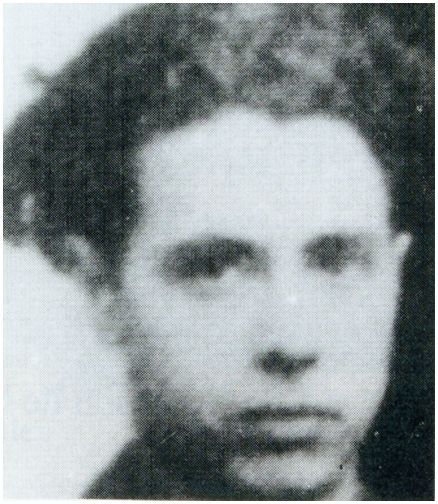
Jean Tinturier, friend of Marcel Callo

Jean Tinturier was born in Vierzon (Cher) on 20 February, 1921.

After completing his secondary studies, he became a seminarian in the diocese of Bourges. In October 1938, he entered the St Sulpice seminary in Issy-Les Moulineaux, then in 1942 the Carmelite seminary in Paris.

Having reached the age required to leave for compulsory service in Germany established by a Vichy law in 1943, he obtained a deferral as a student to complete a training course as a milling machine operator in Dijon and as a turner in Ivry.

The objective was to gain the skills necessary to go to work in support of French workers doing forced labour in Germany and to hide his status as a seminarian.

Called up for compulsory labour service (STO) on 21 September 1943, he left for Schmalkaden with three other seminarians.

In addition to his eleven hours of work per day in front of a lathe, he organised a mass in French once a month for the 150 Christian workers present at the Sunday mass at the local Catholic Church, out of 800 French workers.

He made contact by mail with the leaders of the clandestine Young Christian Workers in Germany to help them provide moral support to each other.

He also made contact with the priests and seminarians of the neighbouring towns: Eisenach, Gotha, Erfurt. They organised and organised reflection meetings.

Among those he contacted was Marcel Callo, who he recruited to assist in his organising work.

As early as March 1944, they learned of the Gestapo’s ban on any religious movement, particularly the YCW. As a result, Jean Tinturier decided to cease all outside activity.

Nevertheless, he was arrested on 18 April 1944 for “illegal activity” and convicted of Catholic Action. While being held by the Gestapo in Gotha, he was interrogated by a specialist in religious matters.

He joined eleven companions arrested for the same reason at Gotha prison.

On 25 September, 1944, he was convicted for the following reason: “By his Catholic action with these French people, during his compulsory labour service, he was a danger to the German state and people.”

Sent to the Flossenbürg camp where he was given the number 28903, he was then transferred to the camps of Mauthausen with the number 108814, then Auschwitz with number 200000, then Mauthausen, with number 123558, where he died on 16 March 1945, three days before Marcel Callo.

SOURCE

T1 Martyrs de la résistance spirituelle, Charles Molette, éd. X. de G., 1999, et Jean Tinturier, C. Molette, éd. X. de G., 2008

The Nerdy-Looking Martyr (Catholic Saints Guy)

Victor Dillard SJ

One of ten siblings, Victor Dillard was born into a bourgeois French family at Blois, not far from Orleans on 24 December, 1897.

During World War I, he served as a second lieutenant with the French army.

After the war, he joined the Jesuits in November 2019, studying theology, law and economics before being ordained in 1931.

In 1937, he was appointed to work with the Jesuit social organisation, Action Populaire, and wrote numerous articles for their journal as well as other Jesuit and Catholic magazines.

When World War II broke out, he became an artillery captain but was captured and made a prisoner in 1940 before escaping.

In 1941, he successfully defended his doctoral thesis on the subject “The evolution of money in France.”

With France now occupied, he began to encourage members of the Resistance and visited political prisoners, activities that drew the attention of the Gestapo.

He considered taking refuge in North Africa. However, the German occupiers imposed Compulsory Labour Service (STO), he decided to join the worker prisoners where he acted as a clandestine chaplain.

After obtaining false papers showing him as a civilian, he was sent to Wuppertal, Germany in October 1943, he worked as an electrician at the Siller und Jamart factory.

Here, he continued to organise apostolic activities, celebrating mass, visiting French workers’ camps, organising study circles among the workers and retreats for the priests.

On 22 April, 1944, he was arrested under the Nazi decree of 3 December 1943, which targeted French Catholic Action groups organising among French workers in Nazi Germany, for “carrying out anti-German policies in the camp”. He was interrogated at the Gestapo premises in Wuppertal, then by the police in Barmen.

Eventually his religious status was exposed causing him to be sent to the Dachau Concentration Camp on 28 November, 1944 as prisoner No. 134064.

He died there of advanced phlebitis on 12 January, 1945, just days before the deaths of Belgian JOC lay co-founders, Paul Garcet and Fernand Tonnet.

After the war, Fr Dillard was posthumously made a Knight of the Legion of Honour .

In 1949, his name was engraved in the Pantheon on the list of “197”, writers who died as a result of World War II or in deportation.

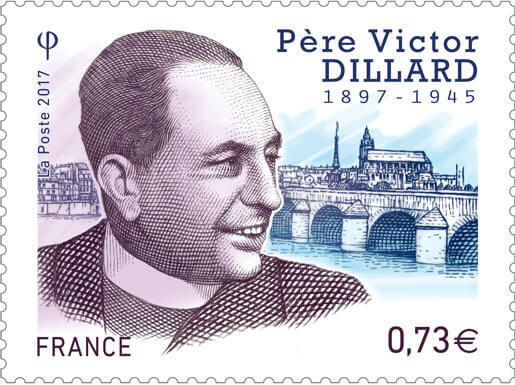
The French government issued a stamp in his honour in 1997.

He is one of 50 French Catholic Action workers and chaplains whose cases for beatification have been sent to Rome.

Compiled by Stefan Gigacz, February 2020.

SOURCES

Victor Dillard (Joseph Cardijn Digital Library)
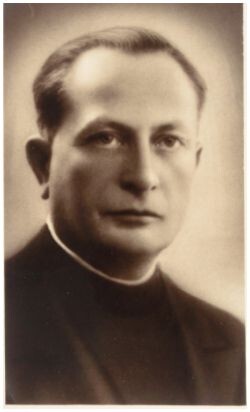
Victor Dillard (Mémoires et espoirs de la résistance)

Victor Dillard (Wikipedia.de)

Victor Dillard (Wikipedia.fr)

Mgr Philippe Verrier, Homélie pour 60éme anniversaire de la mort du père Victor Dillard (Les archives du Forum Catholique)

Claude-Colbert Lebeau

Claude-Colbert Lebeau was born in Paizay-le-Sec on Monday 23 October 23, 1922. After his studies in Châtellerault, he joined the Crédit de l’Ouest bank in Châtellerault.

As a boy he belonged to the Scout movement. Later, he joined the JOC (Young Christian Workers) and became the federal leader of a clandestine group in the occupied zone.

He was called up in March 1943 for the STO (Compulsory Work Service) and responded to the call of the Archbishop of Paris, Cardinal Emmanuel Suhard, who encouraged priests and active members of the JOC to go and join the young Catholics already in Germany.

As he said himself:

“I have to go. Young workers will need me. There, they will be subjected to all the Nazi pressures, they will need me.” 

As a result, he was assigned to a coal factory near Leipzig. His strong faith supported all the young workers whose working and food conditions were difficult. He even organised clandestine meetings with his Christian brothers.

In December 1943, the German authorities threatened to punish religious activities by monitoring and controlling the mail. He was then arrested by the Gestapo on 13 September, 1944, tortured, imprisoned, and then deported to the Zöschen forced labor center, where he continued to help others.

Tortured, he was sentenced and sent to a disciplinary camp from which he would not return, like four of his comrades.

 “Providence placed me here when no other leader had taken the destiny of young workers in hand,” he wrote in a letter to a friend.

“I plant the cross of Christ, helped by my comrades; it is a splendid mission that falls to us,” he continued.

Aware of the risks, he added:

 “This is not the time to back down, not even to hold on.” It is time to announce… It is time to support separated families… It is time to bring to all the guys the testimony of Christ… Yes, it is forward that we must go, it is everywhere that Christ must penetrate and this penetration, it is we who must do it .”

He died of exhaustion on 3 January, 1945, aged 26. His body was repatriated and buried in the Saint-Jacques cemetery in Châtellerault.

A plaque commemorating Colbert was blessed on 8 May, 2017 by Bishop Pascal Wintzer in the church of his baptism in Paizay-le-Sec and another plaque was affixed to the town’s war memorial.

“Colbert Lebeau understood that he had to respond to the call, to be faithful to his vocation as a YCW member,” Bishop Wintzer noted.

“For him, it was a double fidelity, a double love, love of the Lord and love of the workers, in Châtellerault and also in Germany when they were exposed to adversity, constraint and peril.”

“The Lord designated seventy-two more, and he sent them two by two, ahead of him, to every town and place where he himself was going . Through Colbert Lebeau, through many others, the Lord therefore went to Nazi Germany, he went to the labour camps, and even to the extermination camps? Yes, but he did it under the sign of the cross, under the sign of shared suffering.”

“This 8 May, the anniversary of the victory over Nazi Germany, we must not forget. Colbert Lebeau, a man faithful to God and to himself, asks us to be always faithful to the martyrs of yesterday and today. Faithful to the courageous men and women who said no to totalitarian regimes or risks. Let us not forget… at the risk of remaining silent when freedom is in danger.”

In conclusion Bishop Wintzer quoted the words of Elie Wiesel: “I will never forget this, even if I were condemned to live as long as God himself. Never.”

Sources and image rights: Association of Friends of the Resistance Foundation

https://www.causesanti.va/it/santi-e-beati/cayre-cendrier-vallee-mestre-e-46-compagni.html

https://www.vaticannews.va/fr/pape/news/2025-06/pape-leon-martyrs-beatification-france-resistance.html

https://www.paroissesaintpierre2.fr/colbert-lebeau-un-martyr-dans-notre-paroisse/

https://www.poitiers.catholique.fr/hommage-a-colbert-lebeau/